Bilingual Learning Experiences for the Holidays

Holidays may bring extended breaks from school, but that doesn’t mean they aren’t a fantastic time to offer your children some unique learning experiences. In fact, the holidays are rich with opportunities for kids to broaden their knowledge on cultural and communicative topics, if parents provide them with the tools to learn. Let’s take a look at some of the fun and innovative ways children can expand their bilingual learning experiences at home during their holiday breaks from school.

Holiday Bilingual Learning Experiences

The fact is, children master the art of becoming bilingual much easier through immersion learning – or being all-encompassed in dual languages both in school and out. It goes without saying then that parents who make a point to incorporate language learning at home give their children a more thorough understanding of second languages and the greatest chance at being truly fluent in both as they grow.

So how do you go about incorporating a second language in learning experiences at home – especially over the holidays or extended times away from school? One of the easiest ways is by adding various cultural experiences to your family holiday repertoire in order to let your child see first-hand how other cultures celebrate the season.

Ways to Incorporate Cultural Learning Over the Holidays

There are virtually unlimited ways in which parents can add cultural learning experiences for their children over the holidays, so it’s really up to you which angle you choose to take. You don’t need to plan a trip to a foreign country in order to give your child a bit of immersion learning over break. There are things as simple as baking cookies from various cultures to acting out traditional activities practiced around the world – all of which will give your child an invaluable cultural experience and a better understanding of how others celebrate during this time.

If your child is enrolled in foreign language learning in school, that is a great place to start when considering cultural holiday learning activities. To expand on their learning, take a look at the traditions and practices of the language they are studying in school and plan some activities at home that will expand their understanding while they’re home on break.

Depending upon the culture, you could add a holiday baking day that allows your children to experience the various sweets enjoyed by their language of study. You could also prepare a holiday dinner together using the traditional foods and preparation of that culture. If food isn’t your thing, try looking into other traditions of the culture such as candle lighting ceremonies, parades, or even things like hiding brooms or placing shoes by a window – each culture has their own celebratory methods that are sure to enhance your child’s learning experience.

Keep the Learning Growing at Home

There are so many festivities and traditions celebrated by different cultures each year during the holiday season. Being on winter break from school doesn’t have to mean a break from learning – bring some culture and immersion learning into your child’s routine by trying new experiences and adventures related to their language learning. Do a little search to find out area festivals or activities you may have nearby or get ideas on how you can add fun learning tricks at home!

Hour of Code

The Hour of Code is a global movement with students participating in 180 different
countries.  The Hour of Code takes place each year during Computer Science Education
Week. The 2019 Computer Science Education Week will be, but you can host an Hour of
Code all year-round. The purpose of the ‘hour of code’ is to get students to learn about
computer science for one hour.
This week Tessa students participated in the “Hour of Code” it was a great time where all our
students in each classroom were introduced to this new beginning concept of coding
through games, a new “window of learning” in which they can explore (movement, direction,
and location) with fun interactive (and hands-on) age appropriate activities.
What is coding? Coding (or programming) is the basic language of the digital age. It involves
the process of creating step-by-step the instructions a computer understands and needs in
order for its programs to work. Coding gives children the ability to understand how to “tinker”
and shape their digital world.

Early coding or precoding, offers children experiences that integrate communication,
thinking, problem solving and opportunities for interaction and collaborative learning are 21st
century skills that are valuable for children’s future and success in our digital world. Also, they
are aligned with our school’s mission.

– Communication: through the precoding activities children are involved in directional
language, such as up and down, backward and forward, left and right.
– Thinking: Coding helps children develop new ways of thinking and takes the fear of
making mistakes or failing. 
– Problem Solving: Students can consider multiple paths to get to a solution and
choose the most efficient strategy. It teaches persistency in finding a way to solve
your problems. In these activities, planning ahead is the key to success.
– Collaborative learning: children understand the value of working with others and the
importance to contribute with their thoughts and bring support to others and learn
together.

Children became confident with early coding and each classroom used it in different ways to
complement other learning opportunities in the preschool classroom.
– Coding games through the stories: Teacher used children’s favorite story and read-
aloud in the class as the base for coding games. This helps children develop
vocabulary and a greater comprehension of texts.
– Robot Mouse: The mouse comes with different attachments that move it in different
directions.  Children can attach the different segments together to create a unique
path for the mouse to move and find the cheese.
– Unplugged coding activities: Teachers introduced coding without using a computer.
They created a fun printable game that used the same concept of directional cards,
one per space on the grid, to move the pirate to his treasure; the fish to the lake; the
boy to his house and the octopus to his friend the dolphin.
– Apps: Children were exposed with a limit of time to “Code Kart” and “Coding Safari”
apps.

“Hour of Coding” was a great experience for teachers and students and not only helps
improve their mathematics but also gives them valuable skills in life.

In this link you can find a variety of fun activities to do at home.
https://teachyourkidscode.com/free-coding-activities-for-hour-of-code-week/

Lights on Our After-School Program

After-School Program at Tessa 

Tessa strongly believes that providing an effective after-school program to our students is to give them the chance to develop new skills and confidence. Fortunately, Tessa parents have a wide range of creative activities when it comes to choosing high-quality after-school activities for their children. As of today, more than twelve after-school activities, ranging in age from Pre-K through Grade 8, are available in various areas including language, music, art, theater and sports. Out of all of them, after-school language classes in French, Mandarin and Spanish are the pioneer programs at Tessa. The goal is to give all children a meaningful foundation in the language through games, songs, art and more. This entire program is led by dedicated teachers who understand the necessity to teach from an early age and strive to provide the best education. 

Here are some highlights for the January – April term:

Woodworking – Tuesdays, 4:00 – 5:00

2e72b0bc 88d6 45b4 9f1b 58b210117a12

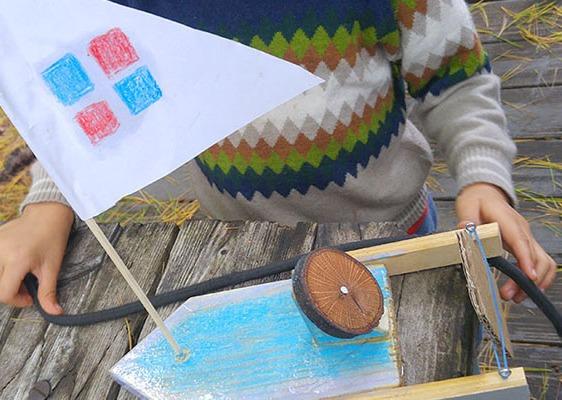
The Woodshop afterschool program will focus on learning the use of manual woodworking tools such as sanding blocks, clamps, hammers, screw drivers, small saws, manual drills to build projects out of wood. Students will plan, measure and build their projects while learning concepts in math, geometry, engineering and physics. Each student will learn the safe use of hand tools, measuring and level aids, woodworking techniques as well as wood protection and the use of natural finishes. Handling real tools increase fine and gross motor skills, hand eye coordination and spacial reasoning.

This year we will concentrate on a curriculum of engineering projects such as pulleys, levers, cranes, wheels and axles and other projects with moving functional parts. Students will build each project during a course of a few weeks and take them home when finished. Each semester students will bring home 4 to 5 finished projects.

Little Gardeners and Artists – Wednesdays, 3:30 – 4:30 pm – January only

32451ce0 f2f1 4aae a698 4811ae5ae404

Join us for 4 fun weeks of STEAM activities where we will learn about the life of a plant while using our creativity to make nature-inspired artwork. Activities involve artwork with leaf impressions and making our own ceramic pinch pots that we will grow our own plants from. Fee includes materials and firings.

TessaPrep – Russian – Thursdays (registration will be available soon)

If you have already enrolled your child in Tessa after-school program then you made the right decision, if not we are waiting for you! Enroll now. 

What Are the Origins of After-School?

To understand where the after-school program comes from, it is necessary to go back to several social and economic events throughout history.  First of all, the presence of more and more women in the workforce, especially during the World War II had a considerable impact. Indeed, as women became the main source of labor, they had no other choice than leaving their children unsupervised after school hours. Then when the child labor law was enacted, forbiting child hiring for all factories, children got more free time without parents. With the economic development of the United States, more and more urban areas were built, so children had to play often out in the streets which led to health and safety concerns. Therefore, after-school programs were presented as a way to minimize exposure to such negatives influences and start receiving many sources of funding. Nowadays, after-school program has evolved and is no more a matter of safety but a booster of academic performance for the children of working parents.

Today more than 10 million children in the US so nearly 1 in 4 families currently has a child enrolled in an after-school program.

The Benefits of After-School Programs

Parents across the United States agree: after-school programs are vital to a child’s success. 

Image result for after school programs

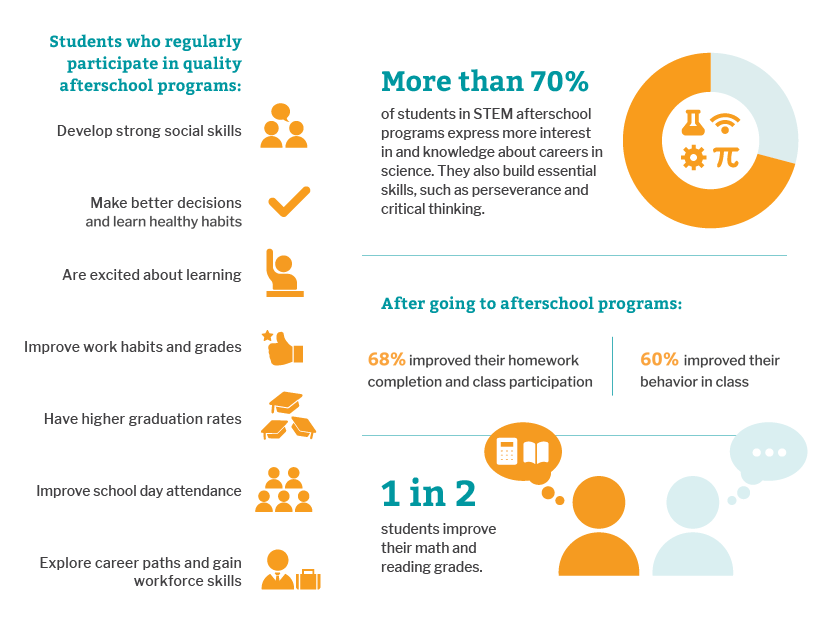
Effective after-school programs can bring a wide range of benefits to youth, families and communities. They can boost academic performance, reduce risky behaviors, promote physical health, and provide a safe, structured environment for the children of working parents.

Thanks to these programs, children can develop strong social skills, they get the chance to know different kids than those they see at school so the program can give them a chance to connect with familiar kids in a different environment and so avoid social issues.

These programs can also improve classroom behavior, school attendance, and can lead to higher graduation rates thanks to teamwork, leadership and critical thinking skills learned during the program.

After-school programs can also play an important role in encouraging physical activity and good dietary habits. After-school sports will additionally help your kid to develop their competitive spirit as well as their focus, stress management, and mindfulness. 

Source of infographie : https://afterschoolforamerica.org/

Role-Playing 101: Why Children Learn Faster with Interactive Activities

One of the key staples of childhood learning and play is acting out different scenarios through a variety of means. We’re talking, of course, about role-playing activities. These activities usually involve your child imagining themselves in various situations in which they play out pretend dialogues either on their own or with others. Some common role-playing scenarios can include pretending to be a mom or dad to “play house,” super hero or emergency personnel play (think police officers versus “bad guys” or firemen saving a home), and even situations like pretending to be a teacher or grocery store clerk.

Witnessing these instances, many parents assume their child is simply participating in imagination play and don’t give much stock to its importance. The truth is, however, these role-playing scenarios are an immensely important part of a child’s learning process and can be a fantastic teaching tool for parents and educational professionals looking for ways to bring about a deep understanding about different concepts and lessons. The benefits of role play learning are an invaluable part of the learning process that stay with children throughout their lives.

“Role play moves a step beyond the dialogue and places students in a situation in which they are called upon to cope with the unexpected or with a new setting using the material they have learned through dialogs and other classroom activities,” explains South Carolina’s Department of Education.

Role-Playing 101

Role-playing is a multi-faceted teaching and playing activity that allows children to grow and learn through imaginative scenarios. Since these activities place children in interactive situations requiring them to work out solutions and reactions on their own in order to play out the role, this type of play often brings about a deeper understanding on topic of play. Essentially, role-playing combines teaching techniques which allows children to grasp a concept much more thoroughly than traditional teaching means.

It’s no surprise that children learn from experience, no matter their age, so by allowing them to act out various experiences on their own, we’re essentially arming them with unlimited learning opportunities. Since the sky’s the limit with role play, there are an infinite number of potential teaching and learning experiences for children every single day if we know how to harness and encourage the techniques.

Including role-playing activities in a classroom daily – whether structured or unstructured – will only serve to boost the learning potential of students by getting them to actively participate in their education without even realizing it. In fact, the skills that children pick up from these role-playing scenarios are invaluable tools that will stick with them throughout their lives, arming them with the tools they’ll need to work through practically every situation they face in their adult lives years later. Role-playing is so much more than simply pretending to be another person; it gives children the chance to try on new roles and work their way through different challenges.

The Benefits of Role Play Learning

When children put on different costumes and act out scenes during play time, they’re doing so much more than simply playing dress-up. Role-playing allows kids to try on different hats – both figuratively and literally – and imagine what it’s like to be in that role. This is a key teaching tool because it puts children in the driver’s seat of learning by cognitively processing what they believe would happen in each situation. To put it simply, role play allows children to gain a better understanding of any given scenario because it gives them the opportunity to see things from a new perspective and to use their minds to work through them.

This opportunity is one that is brimming with new connections and gaining a deeper knowledge of those around them. Some of the greatest benefits of role-playing are centered around the social and emotional growth that stems from the empathy children gain by putting themselves in someone else’s shoes and learning to cope with different struggles and obstacles that arise in that experience. This kind of play allows children to explore different sides of real-life situations, which in turn gives them a greater knowledge on how their actions affect others around them. Some of the most important benefits gained by role-playing include:

  • Developing empathy towards others by experiencing new perspectives
  • Increased problem-solving skills
  • Improved self-expression through communication
  • Learning to work better with others
  • Gaining better social and emotional skills

Invaluable Experiences with Role-Playing

Since role-playing experiences feel more like playing than a more rigid lesson plan session, children tend to gravitate toward these activities without even realizing they are learning in the process. This is a part of what makes role-playing so invaluable. Another part of its interactive genius is that it allows children to gain a better perspective on who they are and who they may want to be when they are adults. Role-playing is often the best way for children to discover what they truly enjoy and to explore different avenues of interest in a way that lets them try out new roles.

Something as simple as putting on a police hat or a white lab coat can allow children to experiment with various careers and areas of interest. By pretending to be a police officer, children can use their imaginations to harness a desire to help others or be the protector. Putting on a stethoscope and grabbing a toy medical bag can allow children the opportunity to explore what it’s like to take care of those around them. Virtually every scenario is ripe with the chance for children to see what kind of interactions they are drawn to the most – something which will come into play quite a bit in the years to come.

While trying on various outfits and acting out different careers and roles can help children develop crucial social and emotional skills as well as allowing them to gain a better understanding of their own interests, the most important part of role play learning is something much simpler. By giving them the opportunity to act out a variety of situations, role-playing teaches children they can be anything they choose. It allows them to envision themselves in a multitude of situations, giving them the confidence and foundation for realizing their true potential in the coming years.


Are you ready to discover Hoboken’s leading international private school?

Contact Tessa International School to learn more!

Thanksgiving at Tessa

At Tessa International School, we love celebrating holidays! Thanksgiving is one of our favorites. Every class is doing this differently, but basically the idea is to give thanks to those who have helped us throughout the year.  This can be clearly seen in Ms. Pooja’s and Ms. Patricia’s class:

What does Thanksgiving Day celebrate?


When it comes to Thanksgiving, there are legends and there are realities. Though the truth of the original meeting is far from what we idealize, today, Thanksgiving is all about putting aside our differences and giving thanks. Though not a religious holiday, some families choose to commemorate thanking God for the harvest. It is often a day to celebrate the family.

When is Thanksgiving celebrated?

In the United States Thanksgiving is observed on the fourth Thursday in November. In Canada it occurs on the second Monday of October.


What do people do to celebrate?

The day is a national federal holiday in the United States. Most people have the day off as well as the Friday following, making a long weekend for travel and holiday.

The way most people celebrate this day is by getting together with their families and having a large meal. Many people travel all over the country for large family gatherings on this day.

Many cities have large parades on Thanksgiving Day. Perhaps the largest and most famous parade is the Macy’s Thanksgiving Day Parade in New York City. 

Another popular way to spend the day is watching NFL football. There are generally a number of football games on even though it is Thursday. The Detroit Lions are a traditional team that plays a game nearly every Thanksgiving.


Traditional Food

The traditional food for the Thanksgiving meal includes a turkey, cranberry sauce, potatoes, sweet potato casserole, stuffing, vegetables, and pumpkin pie.


Fun Facts About Thanksgiving

  • Each year a live turkey is presented to the President of the United States who then “pardons” the turkey and it gets to live out its life on a farm.
  • Around 46 million turkeys were eaten in the US on Thanksgiving in 2010. That’s around one fifth of all the turkeys eaten for the entire year.
  • Benjamin Franklin wanted the turkey to be the national bird instead of the bald eagle.
  • Around 88 percent of Americans eat turkey on Thanksgiving.
  • The Pilgrims sailed to America from Great Britain on a ship called the Mayflower.
  • The day after Thanksgiving is called Black Friday. It is the biggest shopping day of the year.
Image result for thanksgiving wallpaper


What does an International Education truly mean?

From November 18th to November 22nd, schools across the United States will celebrate the International Education Week. This upcoming event had us reflect upon our connection to this and how we try to promote cultural and language exchange.

What is the International Education Week?

Let’s start with a bit of background. The International Education Week is an initiative from the U.S. Department of State and the U.S. Department of Education, created to celebrate the benefits of international education and exchange worldwide. It is an annual celebration of cultural diversity and international opportunities.

International Education at Tessa

A truly international education is a combination of various factors. Here at Tessa we focus on three main criteria to prepare our students to become bilingual, adaptable and active citizens: Bilingualism, Interculturalism and Diversity.

Bilingualism

Bilingualism is maybe the first element educating our students towards a better understanding of our globalized world. Several studies and researches indicate that bilingualism has many benefits on the brain and opens unique life opportunities.

www.BilingualKidspot.com

Interculturalism

The importance of intercultural communication and understanding is often underestimated. We tend to assume human beings behave similarly in given situations. The reality is that depending on our social background, family and country, we all have different customs, standards, social mores, and even thought patterns.

At Tessa, Interculturalism is at the heart of our curriculum, and we believe immersing our students in not only one but several different cultures is a key factor in their development. At Tessa, children are introduced to other languages and cultures as soon as 2 years old. Such an exposure enhances their cultural awareness; they quickly become bilingual and culturally adaptable.

Diversity

What makes a cultural immersion possible at Tessa, is the amazing diversity among our team and families. It is a big part of our identity as a school, as well as a community and we take much pride in it.

Teachers get to share their country of origin traditions during celebrations or before holidays. We also love to welcome parents at school; they explain their own traditions to the students, how they celebrate it at home and what it means to their family. With its parade and various booths, our United Nations Day celebration was as well a mean to learn from each other.

We recently started mapping that diversity among our community and it simply looks amazing!

We believe that giving your children the gift of an international education will benefit all of us as they will have a lot to offer growing up.

Do Anti-Bullying Programs Really Work?

With a whopping three quarters of all school-age children reporting they have witnessed or been a part of bullying at school, anti-bullying policies have quickly become an imperative part of school regulation. By now, nearly every educational institution across the country has a program in place to monitor and combat this behavior, but do anti-bullying programs really work?

Bullying Behavior

According to Psychology Today (PT), “Children and adolescents become bullying targets for a wide variety of reasons though race, ethnic background, appearance, or sexual orientation appear to be the most common.” The bullying behavior can come in all sorts of actions from physical intimidation to being ignored by a former close friend. Since there are so many different forms of bullying, it’s often difficult to spot. This is where anti-bullying policies come into play.

Anti-Bullying Programs

Anti-bullying programs range in tactics from informative assemblies and visual reminders (posters and signs, for example), to more hands-on approaches that utilize hall monitors and effectively trained staff to watch for signs of bullying throughout the school grounds. Generally speaking, the most effective policies combine a multitude of approaches and begin at the earliest of ages.

What These Policies Target

In addition to informing students of what behaviors are not acceptable, teachers and staff are usually trained in-depth on the various behaviors to watch for in order to gain the most efficient and safe anti-bullying experience for students. Educators are taught to watch for things such as a change in demeanor, isolation of a student, changes in performance, and many other behaviors which could indicate bullying.

Do Anti-Bullying Programs Really Work?

With so much training and effort going into anti-bullying programs today, many have asked the question: do they really work? As Psychology Today explains, the effectiveness of anti-bullying programs is usually reliant upon the vigilance of those implementing it. In other words, it’s not as simple as saying they work or they do not work, it’s more to do with the attention and determination of the staff and families of students.

“Ultimately, what really determines whether anti-bullying programs are effective is how well the anti-bullying guideline are followed in schools,” PT states. Since the level of participation and attentiveness varies from every location, it’s easy to understand why diligence is key to a successful anti-bullying program.

How to Improve Anti-Bullying Programs

In order to ensure anti-bullying programs have the highest possible rate of success, there are a few important factors to keep in mind. For starters, thwarting bully behavior is something that takes the utmost of attention and detail – it’s more about the action and less about the passivity.

Acting on bullying behavior means that educators and parents must both participate in a clear-cut set of consequences for anyone caught bullying. These consequences may need to be adjusted throughout the year in response to the effectiveness, so ultimately, the plan must be severe enough to make an impact but flexible enough to stay relevant.

The most important thing an anti-bullying policy must include is priority. The safety of students needs to be the number one priority, even above teaching duties, in order to have the largest impact on bullying behaviors. Students must know they are being taken seriously and that they are safe in their surroundings, as well as understanding bullying behavior is absolutely not tolerated.

Learning and Teaching at Tessa is a celebration

Learning and Teaching at Tessa is a celebration.

At Tessa, we celebrate each of our transdisciplinary themes.  It is a celebration to the Learning and Teaching of approaches to learning, inquiry, concepts, language and the learner. 

The transdisciplinary model inherently promotes student agency. It encourages the integration of many ways of knowing, and perspectives from all members of the learning community, to make sense of a world that has become “too big to know.”

Our transdisciplinary themes or units last for 8 to 9 weeks. Last Friday, November 1, we had our first End of Unit Celebration on “Who We Are” unit. Parents are invited to come and see the final projects of their child. The celebration is in respective classrooms and could be presented in a performance or documentation of what the student learned throughout the exploration of the central idea, lines of inquiries and key concepts. 

In each unit, teachers at Tessa incorporate the importance of approaches to learning skills. These are a set of skills that we use when we are involved in learning. They come grouped into five sets: Thinking, Social, Self-Management, Research and Communication skills. They naturally have growth mindset occurring within them, since they cover many different behaviors, self-control as well as thinking and communication strategies. 

In other words, the Learning and Teaching celebration invites the learning community and the learner to present a summative assessment of the essential skills, concepts of inquiry to show the progression of sub-skills. Some examples of sub-skills such as critical, creative thinking, listening, speaking, emotional intelligence and mindfulness. In each transdisciplinary theme, the learner gets to improve in all these skills in the wholeness of Learning and Teaching.  

PSPE at Tessa, a “Whole Child” education

Greetings from the land of PSPE & Yoga. I first want to state that this year has unfolded as a challenging yet fulfilling constant state of engagement.  Students are working in tandem with me to create consistent routines while building their hand/eye coordination, explore capabilities in knowing their bodies and what they are capable of, learning new content each class, threading consistent movement with the new and more difficult body exploration, connecting, and evolving daily. 
As an educator, the IB/PYP approach to movement and strengthening for students at every grade level is both a breath of fresh air and fascinating. Personal, Social & Physical Education (PSPE) spans the scope of what I have personally described as  “Whole Child” education. The breadth, scope & connection in terms of academic enrichment, the emotional child, the social environment provides both the educator (myslef) as well as the student (your precious child) a safe space to reach beyond limitation.

Though I work in movement with the students, there is a commitment to folding academic inquiry and grade level curriculum into our weekly practice. This perspective (from a physical education standpoint) is cutting edge, supportive, challenging and rewarding for creative minds.  It feels like a perfect fit for me here at Tessa as it is both conducive to my passion and wildly exciting for me personally.  
I am always willing to speak with parents about student challenges, gifts and growth throughout the year.  I wholeheartedly belive in this approach to teaching and learning.  Thank you for the opportunity to teach, learn and adapt to the needs of the “whole child” as the PSPE/Yoga teacher.

What to do When Your Child Is Being Bullied

With the majority of schools today participating in at least some form of anti-bullying policies, most parents have been made aware of the movement to stomp out the aggressive behavior. While we may be more actively approaching bully behavior today, many may still be uncertain of what to do when your child is being bullied.

Classic Bullying Behavior

When we think of classic bullying behavior, we usually envision things like stolen lunch money or toys, bruises or other signs of fighting, or clothing being ripped or destroyed. These things are considered aggressive bullying and usually fairly easy to spot. Unfortunately, bullying goes unnoticed often times because it rarely fits into this category.

Less Obvious Bullying Behavior

Bullying is usually thought of as mean-spirited behavior that is manifested through physical and verbal means. The truth is, however, bullying behavior can take on many different forms – it isn’t always taunting, teasing, or physically fighting.

While it’s certainly true that scenarios involving pushing, picking, yelling, and teasing are examples of classic bully behavior, there are other, less obvious forms of bullying as well. Often times, kids can experience the effects of bullying by way of being ignored by their peers, being left out of games and functions, and even things like whispering, and note passing.

“More often than not… bullying is difficult to spot. Most kids don’t come home from school saying, ‘I’m being bullied every day by these three kids and I’m really scared and unhappy,’” explains PBS.org.

Are There Signs Your Child Is Being Bullied?

Knowing that the signs of bullying aren’t always easy to identify, one of the best things a parent can do to help their child is to know what behavior warrants anti-bullying tactics. This may seem easier said than done, but by understanding warning signs in your child, you can help stop bullying in its tracks.

So, just what are these warning signs? Similar to the signs of bullying, there are more obvious signs your child is being bullied, as well as less obvious signs. Paying attention to your child’s behavior versus what they are verbally communicating is key to getting through a rough time.

Most Obvious Signs

The most obvious signs a child is dealing with a bully at school (or on the bus, playground, or even neighborhood after hours) are usually physical signs. Aggressive bullying is often the culprit of these type of signs and can include things like a disheveled appearance when they should otherwise be presentable, physical scars and bruises or bleeding, and complaints of aches and pains with no rational explanation for them.

Since kids don’t usually tell you when they’ve had an altercation with another child, it’s usually up to the parents to pay attention to their physical appearance. This can also include their attitude – a sudden change in attitude that involves crankiness or irritability can often point toward a bullying scenario as well.

Less Obvious Signs

If your child isn’t coming home with bruises or torn clothing, but you still feel like something is “off” with them, don’t discount bullying yet. As we mentioned earlier, there are many forms bullying can take and, as such, there are many forms their reactions can take.

Some of the less obvious signs your child is dealing with a bully can include being withdrawn, a loss of interest in things they previously loved to do, and seeming sad or depressed upon coming home. Other signs to watch out for include a change in their appetite – usually a loss of interest in eating altogether, trouble sleeping (night terrors and bad dreams included), and frequent ailments like headaches or stomach aches.

Major Red Flags

There are a wide range of signs and symptoms of bullying – all of which need addressed as soon as possible – but some may require much more immediate attention. Depending upon the individual situation, children will handle a bullying experience in their own way; however, certain behaviors should always be taken seriously as soon as they surface.

If your child’s school performance begins to change – this is a huge red flag that something is off with them, usually relating to a person or situation at school. Other major red flags that should be addressed immediately include visible signs of fear or panic when they are faced with a task (anxiety over riding the bus or fear for going to class, for example), or any form of discussion involving loss of life or suicide. Noticing any of these behaviors warrants direct and swift attention by parents and teachers.

What to do When Your Child Is Being Bullied

If you’ve noticed your child experiencing any of the above-mentioned signs of being bullied, you’re likely wondering what you can do to help them put a stop to the situation. For a parent, watching their child go through a bullying situation can be one of the most heartbreaking and difficult things to witness. Often times parents wind up feeling helpless or can end up taking steps that may make things worse for their child by accident. So how do you know what to do?

In many cases, schools and other childhood educational and care facilities will have their own form of anti-bullying policies already in place. A look through their school handbook or a discussion with their direct-care professionals can help lead you on the right path for helping your child. Outside of this, there are certain things parents can do to ensure they are taking the right steps to combat their child’s bullying experience.

Anti-Bullying Behavior at Home

There are several things parents can do at home, outside of an anti-bullying policy at school, that will help children get through being bullied. For starters, the most important thing is for parents to be vigilant about monitoring their children’s behaviors so they can quickly spot any of the signs of bullying.

Other steps parents can take to be proactive about bullying:

  • Talk to your child: ask them how things are going, share with them what you’ve noticed and gauge their response.
  • Ask, don’t assume: we may be tempted to ask them what they did to warrant a certain behavior, this can lead them to believe the bullying is warranted.
  • Talk with others in their lives: speak with others who are near your child during the bullying situations and have them help determine a “safe” person they can go to when they feel bullied.

Overall, the best thing you can do for your child if you suspect they are the victim of bullying, is to be their ally. Know what to watch for, make sure you reiterate with them that you are always there, and equip them with the tools to overcome the situation by giving them a safe space or a safe person to go to when needed.