

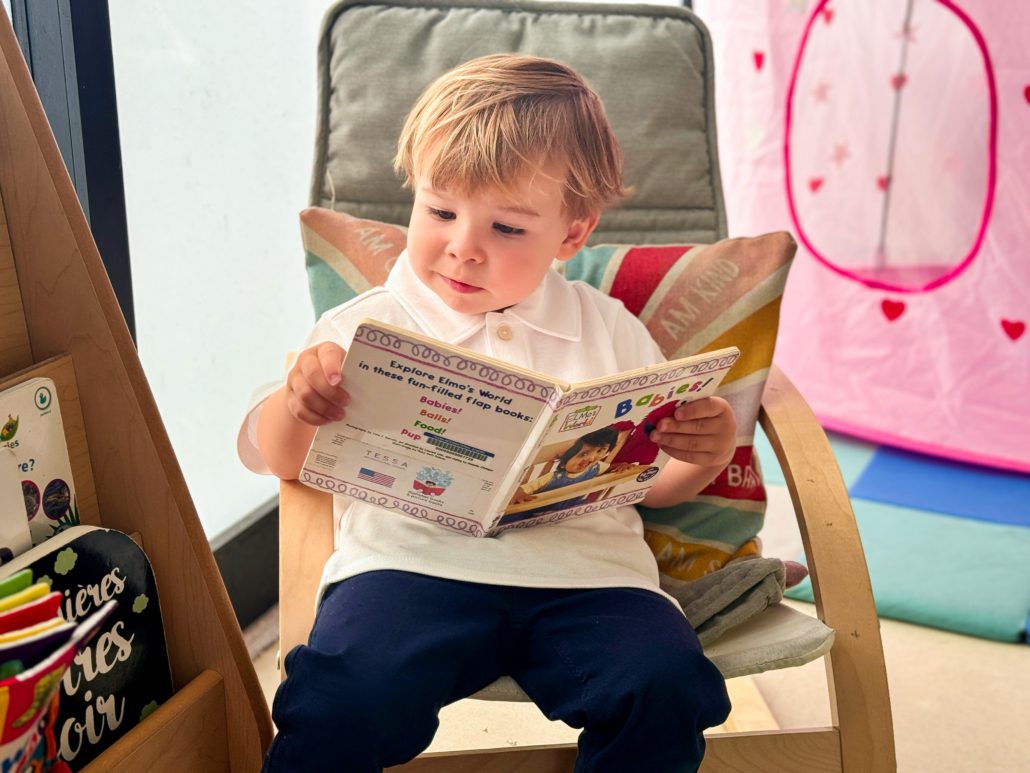
How Bilingual Children Develop Reading Skills in English
This is the fourth post of our Literacy Progression Series. Read the previous post here.
One of the most common, and completely understandable questions we as bilingual educators hear from families is:
“When will my child learn to read in English?”
The short answer is: they will.
But the more meaningful answer involves understanding how bilingual children build the foundation for reading and why their path may look a little different from that of monolingual children.

Early reading skills start sooner than many expect.
Reading Builds on a Foundation of Language
Before children can begin to read, they need to develop a strong command of spoken language. This means:
- Understanding how language works
- Recognizing the sounds that make up words
- Building a broad and meaningful vocabulary
- Connecting symbols and words to real experiences
At Tessa, children develop these skills in their target language first through stories, songs, conversations, and purposeful writing and drawing (learn more about our 80:20 Immersion Stage here). By the time formal reading instruction begins, children already understand that print carries meaning, and they have spent years immersed in rich, meaningful language experiences.
The Role of English in the Early Years
In Nursery through Pre-K, English is the social language of the playground and lunchroom. While children are immersed in Spanish, French, or Mandarin for instruction, they still hear, speak, and build oral language in English every day.
In Kindergarten, we introduce daily English literacy instruction alongside continued immersion. By this point, children are developmentally ready to begin learning formal reading strategies, and they are able to draw on the sound awareness, vocabulary, and symbolic thinking they have developed in the target language.
This is when English literacy begins to take shape, but it is not starting from scratch. It is built on a deep foundation of early literacy in another language.
Reading in Two Languages Is a Strength
Some families worry that learning in a second language first may delay reading in English. In fact, research shows the opposite.
Bilingual children may sometimes start formal reading a little later than monolingual peers, but they often catch up quickly and show strengths in areas such as:
- Comprehension
- Metalinguistic awareness (understanding how language works)
- Vocabulary depth
- Problem-solving and cognitive flexibility
Bilingual readers may take a different path, but it is one that leads to powerful long-term gains.

Research suggests that bilingualism impacts children’s ultimate acquisition of literacy via the beneficial effects of bilingualism overall.
We Follow the Child, Not the Clock
At Tessa, we support each child at their developmental stage. Some children begin decoding in their target language first. Others begin blending sounds in English. Many begin both at once.
We observe their strengths, track their progress across both languages, and ensure they feel confident, motivated, and joyful as readers.
In our next and final post of this series, we will explore the long-term benefits of bilingualism and biliteracy, not just for school but for life.
Are you ready to explore the only international leading private school in Hoboken?
Contact Tessa International School to learn more!
Sources & Further Reading
- National Literacy Trust. (2017). Bilingualism and Literacy: A Research Briefing.
- Genesee, F., & Geva, E. (2006). Cross-linguistic Relationships in Second Language Reading Development: An Overview.
- U.S. Department of Education. (2015). Dual Language Learners in the Early Years: Getting Ready to Succeed in School.
- August, D., & Shanahan, T. (2006). Developing Literacy in Second-Language Learners: Report of the National Literacy Panel on Language-Minority Children and Youth.
- Espinosa, L. M. (2015). Getting It Right for Young Children from Diverse Backgrounds.


